Churchill

In 1970 a new town had been established by the Housing Commission in the Parish of Hazelwood, to supply accomodation for State Electricity Commission workers and their families. The town was planned with the Morwell shire, with provision for shopping and civic amenities. An optimum population of 40,000 people was envisaged for the year 2000.

The Hazelwood Planning Scheme was approved in 1964. The site was chosen for its pleasant location at the foot of the Strzelecki Ranges, overlooking Hazelwood pondage. It was relatively free from air pollution, is not over rich coalfields and is in close proximity to the larger towns and power stations in the Latrobe Valley. The town was to include private as well as Commission estates. The houses were to be all brick and of varied designs. Residential areas were to be grouped around the town centre so that people could walk through parks and under main roads to the town centre. There were to be eleven neighbourhoods named after the district’s pioneering families. Each neighbourhood would consist of about 600 homes grouped around parks, a school and corner shops. There was to be an area for light industry. The proposals were ambitious, with plans for a shopping mall, large department store, market, theatre, civic centre, cultural centre, hotels, offices, bus terminal, racetrack and golf course.

Land was compulsorily acquired and house construction commenced in late 1964. The first families took up residence in late 1965. The town had been known as Hazelwood, the name of the surrounding district and the original pastoral run. But in February 1965, the government changed the name to Churchill to honour the English statesman, Sir Winston Churchill. The local response was very negative and very vocal and it was November 1966 before the issue was definitely settled in favour of Churchill. A bronze coloured structure 102 feet high represents a “cigar”, symbolising the town’s link with Churchill. The issue of the town’s name re-emerged in 1987. After much lobbying, a survey was taken and a close result favoured retaining the name Churchill.

Growth of the satellite town was initially slow so purchase conditions were relaxed. By 1968 the shopping centre was constructed. Progress accelerated by 1969 with more than 100 homes being built each year. Community spirit was strong, with the Citizens’ Association formed in 1966 being a strong force in town affairs.

But then development in the Latrobe Valley slowed, consequently slowing Churchill’s rate of development. Most residents had young families and were critical of the lack of community facilities. During the 1970s and 1980s, a Community Health Centre was established, as well as a Leisure Centre, hotel and secondary school with community library. In 1972, the newly established Gippsland Institute of Advanced Technology began operations at its new site at Churchill. Now merged with Monash University, it has expanded greatly, with approximately 1,800 internal and several thousand external students.

By 1976 the population was 3,500, by 1981 about 4,800 and by 1991, 5,600. Churchill is identified as a University town situated on Monash Way, 9kilometers south-east of Morwell. Monash University Gippsland is located on a 64-hectare campus at Churchill. The town is attractively set out on the foothills of the Strzelecki Ranges adjacent to the 520 hectare man-made Hazelwood Pondage. There are three primary schools, a church, secondary school, four pre-school centres and health and recreation facilities.

Although the town now has many facilities, it is not as grandiose as originally planned. In 1991, the population was only slightly more than in 1986, well short of original projections. A large proportion of Churchill’s workforce was employed by the State government, so that the rationalisation and privatisation of the power industry has had a negative impact on the town. The general economic recession has also been felt severely, with the closure of a lingerie manufacturer previously employing 250 people. However the staff and students of the university contribute to the economic and social welfare of the town. Rather than a self contained town, Churchill has become a pleasant dormitory suburb with people travelling to the larger nearby towns for major shopping and entertainment.

Further Reading:

  • Housing Commission, Victoria. “Churchill: strategy for urban management”. 1979.
  • Housing Commission, Victoria. “Exciting things are happening”. c.1965.
  • Legg, S.M. “Heart of the valley: a history of the Morwell municipality”. 1992.

Tumut

Tumut is a town and a shire 120 km. west of Canberra. It is situated in the Tumut River valley which, while close to the Snowy Mountains, is 280 m. above sea level. The Tumut River enters the Murrumbidgee about 40 km. northwards, near Gundagai.

The valley was explored by Hume and Hovell in 1824. Settlers came in the late 1920s, probably from Yass to the north. The name Tumut is supposedly derived from an Aboriginal word meaning resting place by the river.

By 1852 a town existed on the site of Tumut, but being situated on a river it was inundated in a severe flood in that year. Rebuilding on higher ground followed. The discovery of gold at Kiandra,about 80 km. south-east of Tumut, in 1859 provided a market for Tumut’s primary products. In 1875 The Australian Handbook described Tumutas –

tumut.jpg

In 1887 the Tumut town council was created, within boundaries smaller than the present township. The outer parts were not under local government until the creation of Gadara shire in 1906. By 1903 the area of farmland under cultivation around Tumut was 11,000 acres and a railway connection to Gundagai was opened. The town had a mechanics’ institute andlibrary, an Agricultural and Pastoral Association and several friendly societies.The Tumut district’s tourism potential was promoted in the early 1900s when the nearby Buddong Falls and Yarrangobilly Caves were depicted at an international exhibition. Another industry was started in 1921 with softwood plantings in the Tumut State Forest. A trout hatchery was constructed in 1928, thesame year as when the town and shire council were united to become Tumut Shire. By the outbreak of the second world war Tumut had a caravan park,golf links, reticulated electricity and a sewerage scheme.

The shire contains the townships of Adelong, Batlow, Cabramurra and Talbingo. In the south-east is Yarrrongabilly and (just outside the shire), the place whereKiandra was situated. The Tumut township was described in The Australian Blue Book, 1948, as –

tumut1a.jpg

The postwar period saw the Snowy Mountains Hydro-Electric Scheme inject prosperity and development into Tumut. Upstream on the Tumut River is the Blowering Dam, Talbingo Dam and Tumut Ponds Dam. There are four power-generation stations in the Tumut Valley, using the controlled waters of the Eucumbene,Tooma, Tumut and upper Murrumbidgee Rivers. Any deficiency in water flow is made up by water carried by tunnel from Lake Eucumbene to Tumut Pond Dam. The power station furthest down the valley is at the bottom of the Blowering Dam, the largest of the three storages on the Tumut River. Water from Blowering Dam is also used for irrigation.

The scenic attractions of Tumut were made accessible by the Snowy Mountains Scheme’s roads. Orchards and exotic trees around Tumut add to its scenic attraction. Tumut shire has 119,000 ha. of farmland, of which 83,000 are pasture. In 1994 there were 149,000 sheep and lambs and 65,000 cattle. Little cereals are grown, although high-grade millet is grown for a broom factory(also a tourist attraction).

Large softwood plantations and saw mills are a mainstay of the district’s economy.

Tumut’s census population have been 2,274 (1911), 3,012(1954), 5531 (1971) and 5955 (1966). Tumut shire’s census population have been 7848 (1933) and 10951 (1996).

tumut.jpg


Postcard, c. 1920

King Island

King Island is in Bass Strait, midway between Cape Otway, Victoria, and Cape Grim, Tasmania. Its area is 1,100 square kilometres, and it is part of Tasmania. Its sixty-five kilometres of western coastline faces the roaring forties.

The island was sighted, but probably not landed on, in 1797. It was further sighted by Lt. Matthew Flinders and Captain John Black in 1789 and 1801. Black named it after Governor King of New South Wales. It was frequented by sealing vessels. In 1802 Lt. Charles Robbins in the “Cumberland”, acting on instructions to forestall French occupation, met the Baudin expedition’s ships in Sea Elephant Bay on the east side of the island. Robbins formally took possession of King Island. By 1813 seals and sea elephants were virtually exterminated.

Evidence has been found of Aboriginal occupation, dating from 14,500 years ago to 1,100 years ago. Sites include a cave, middens and stone scatters.

King Island is low-lying, with a maximum elevation of about 160 metres at the south near Grassy. The west side is predominantly undulating grassed sandy loams, once forested but reduced to tea-tree and melaleuca scrub, and windbreaks where remaining. There are many lagoons and lakes, one perched. The east side had greater scenic value and the larger area of tree cover (Pegarah forest and pine plantation). The ecology has been much altered: forests were harvested, the remains falling victim to occasional fierce fires; the King Island emu, seals and sea elephants, wombats and a tiger cat were hunted to extinction. As a balancing item foxes and rabbits have been kept off the island, and introduced turkeys, peacocks and pheasants have multiplied. Cypress-hedge windbreaks are a dominant aspect of the landscape, along with some box thorn hedges. Bracken infestation has become evident on some farms in the north of the island.

Apart from sealing parties, the island was not settled by white people until a lessee took up pastoral occupation in 1855. Farm selections began in 1888. A road trust was formed in 1900, to be superseded by the King Island municipality in 1907. The main town is Currie.

After the first world war a scheelite mine was developed at Grassy (1917) and soldier-settlement farms were taken up in 1919-20. It is believed that the first or second farmers usually failed, but left behind sufficient improvements for the third to succeed. Beginning with the fattening of sheep and cattle, dairying increased in importance. The application of mineral trace elements to coastal farms corrected poor stock conditions, due to an animal ailment known as coastiness. There was further soldier settlement in 1948, and by the 1969s sheep and meat cattle holdings had increased.

main_street_Currie_King-Island

The climate of King Island gives moderate winter and summer temperatures, providing all-year pasture growth. This has been good for milk supply, which ensures a stable rate of cream and cheese making at the King Island cheese factory.

Since 1933 when aircraft first began a regular service to King Island, the island has been promoted for tourism. The most successful promotion has been through King Island’s growing reputation for gourmet foods – dairy products, beef and preserved meats and crayfish. There are regular air services from Moorabbin (two), Melbourne Airport and Geelong (1998), as well as from Tasmania. Currie has the large Parer Hotel, a motel and numerous other accommodation units. There is also accommodation at Naracoopa and Yarra Creek.

Educational facilities are restricted to Currie (years 1-10). Schools have been closed at Reckara (1997), Grassy, Yambacoona and Yarra Creek. The original King Island dairy at Yambacoona lies derelict, and the present factory is a few kilometres north of Currie.

King Island’s western coastline is littered with ship wrecks. The “Cataraqui” is Australia’s worst civilian shipping disaster (400 persons lost, 1845). Strong westerly weather also blows in bull kelp which is harvested and processed at Currie. There are lighthouses at the northerly Cape Wickham (1861, Australia’s tallest lighthouse), Currie (1879) and the southerly Stokes Point (1952). The first two lighthouses and the museum near the one at Currie are registered historic buildings.

King Island’s census populations have been 2,554 (1954), 2,784 (1961), 1989 (1986) and 1797 (1996). The median income of residents aged 15 years of more was $324 a week in 1996. The median for Tasmania was $257 a week.

Further Reading:

Edgecombe, Jean, Discovering King Island, Western Bass Strait, the author, 1993.

Hooper, R.H., The King Island Story, Peko-Wallsend Ltd., 1973.

Wood Michael, Story of King Island, King Island Quik Print, 1990.

Leeton

Leeton is a town and a shire in the Murrumbidgee Irrigation Area. It is 12 km. north of the Murrumbidgee River, 100 km. north-west of Wagga Wagga and 430 km. west of Sydney.

The town is relatively recent. In the early 1900s Hugh McKinney, an engineer with experience of irrigation works in the Indian Punjab, noted the similarity of the Riverina – Murrumbidgee plains to the Indian topography. In association with local pastoralists McKinney’s observation developed into an irrigation plan beginning with the Burrinjuck Dam (1906), on the Murrumbidgee River, south-west of Leeton.

The scheme was greatly assisted by Sir Samuel McCaughy, local pastoralist and member of the New South Wales Legislative Council, who had carried out irrigation works. He was the owner of North Yanco, the site of the future Leeton.

The Murrimbidgee Irrigation Areas Trust erected buildings at North Yanco in 1911. In 1912 the place was named Leeton after Charles Lee, Minister for public Works and a member of the Trust. The following year the Water Conservation and Irrigation Commission (successor to the Trust) added further buildings, including a School of Arts, as more workmen were engaged forirrigation works. It also commissioned Walter Burley Griffin to design thetown. Over 140 town allotments were sold on 2 April, 1913. Schools and churches were established from 1913 onwards, a hospital was completed in 1919, anda railway connection to the Narrandera line made in 1922. The commission established and operated numerous secondary undertakings including a stock sale yards, abattoirs, butter and bacon factories, a power house and canneries. Leeton was also noted for Co-operatives, including dairy farmers (1921),fruit growers (1932), cannery (1935), stock treatment (1937), poultry farmers(1943) and rice growers (1950).

Local government was vested in the Commission until 1921 when an Executive Board was appointed to assist. In 1928 the Willimbong shire was created,with Leeton as the administrative centre. The population of Leeton in 1933 was 3,629.

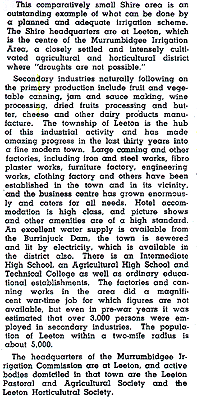
In 1949 The Australian Blue Book described Willimbong Shire (473 sq.km.) as –

leeton1.gif

By 1949 a substantial change had occurred in the social background of farmers. In 1924 61% of horticultural holdings in the Murrumbidgee Irrigation Area had been occupied by soldier settlers and 1% by Italians. In 1949 the figures were 18% and 32% respectively, and in 1972 Italians occupied 75%of holdings. The figure was lower in the Leeton (Yanco) area – 50% – but still a significant presence in the community.

Notwithstanding Leeton’s recent past, it has several buildings of note. The Historic Hydro, originally built for the Water Commission, is a motor inn and reception venue. There are 21 listed Art Deco buildings, including the Roxy Theatre. Leeton is the location of several educational services, including agricultural schools, a TAFE and the St. Francis De Sales Regional College. Sir Samuel McCaughy’s mansion is part of the Yanco Agricultural High School.

In 1993-4 crops in the Leeton Shire (1,132 sq. km.) comprised 11,562ha. of rice, 5,196 ha. of wheat, 2,330 ha. of orchards, 659 ha. vegetables and 474 ha. of vineyards. There were 142,000 sheep and lambs (mainly for meat) and 37,000 beef cattle. Manufacturing locations numbered 21, with a turnover of $373 million in 1991-2.

The census populations of Leeton have been –

Town/locality: 2,793 (1933), 5,148 (1954) and 6,245 (1991).

Shire: 8,992 (1947), 11,359 (1971) and 10,795 (1991).

Further Reading:

Dookie

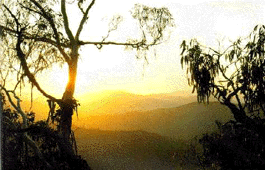
Dookie is a rural township and district 27 km. east-north-east of Shepparton in northern Victoria. The area east of Shepparton is mostly flat, irrigated farm land, but Dookie is set in undulating country with Mount Major to the south of Dookie township. The Dookie Horticultural college is in the foot hills of Mount Major.

In 1859 the Dookie district was surveyed, taking in much of the Emu Plains pastoral run. Local lore has it that Mrs. Turnbull,wife of the station’s proprietor, was so unhappy at the prospect of survey and possible farm subdivision that the surveyor suggested a place name derived from the Singhalese word duka, meaning sorrow. Mrs. Turnbull had lived in Ceylon. Duka was re-spelt Dookie.

During the early 1870s farm selections were taken up and a township site at the foot of Mount Major was surveyed. It was named Dookie South, later Cashel, and adjoins the agricultural college. In 1886 the Dookie agricultural college was begun and two years later the railway was extended from Shepparton to about three kilometres north of Cashel. The town which formed around the station became Dookie. A large vineyard, one of over thirty in the district,was named Chateau Dookie. About 200 hectares of vines were planted and a large wine cellar and distillery were built. The property was converted to general farming in 1910 after vine diseases and a decline in the wine industry.

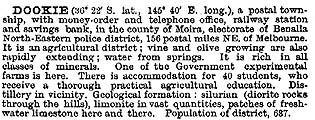
In 1903 The Australian Handbook described Dookie –

dookie1.jpg

There were also three stores, two blacksmiths, two butchers, a newsagent,two hotels, a newspaper, a hospital, Catholic (1898), Presbyterian (1892)and Anglican (1903) churches and a National Bank. The deserted bank is all the remains at Cashel. The school (1872) and the Victoria Hall and library(1892 and 1897) were the town’s cultural centres.

Dookie became best known for the agricultural college. Its origins were the Cashel Experimental Farm (1878), which was replaced by a college for training young people in a wide range of agricultural skills and farm management.As a campus of the Victoria College of Agriculture and Horticulture, Dookie offers a Bachelor of Applied Science (Agribusiness), along with short courses.

Dookie_History-Womens-Classes-at-Agricultural-College


Source : The Australasian, date 30 August 1924

Women’s classes held at Dookie (Victoria, Australia) Agricultural College from August 20 to August 29.

Headings of photographs (left to right) :

1. Instruction in dressmaking
2. Mr. Pye gives a demonstration in plant-breeding
3. A class receives instruction in labour-saving devices
4. Demonstration in tree growth by Mr. McDonald
5. Tree-planting lessons

Dookie township has three churches, a school, a public hall, a hotel,stores, a golf course, an oval and tennis and bowling facilities. There is an agricultural and pastoral society, the successor to the Moira society(1877).

Dookie’s census populations have been 30 (1881),410 (1921), 320 (1954) and 174 (1966).

Further Reading:

  • Aldridge, Roger, “Dookie College: The First 100 Years, Victorian College of Agricultural and Horticulture”, 1986.
  • Feldtmann, Neil, “Dookie, the Years to 1988”, Dookie Centenary Committee Inc., 1988.
  • Wallace, Sue, “Shepparton Shire Reflections, 1879-1979”, Shire of Shepparton, 1979.

Healesville

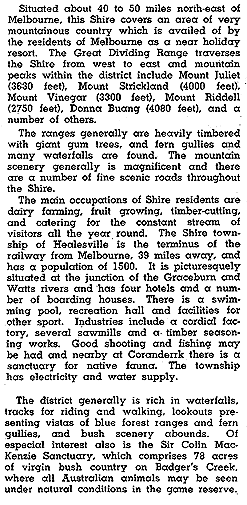
Healesville is a township 52 km. east-north-east of Melbourne, just south of the Watts River which is a tributary of the Yarra River. Upstream from where Healesville is situated gold was foundat New Chum Creek in about 1859. By 1860 New Chum was a village. However,it was the creation of tracks to the more distant Gippsland and Yarra Valley goldfields in the 1860s that resulted in a settlement forming at Healesville and its survey as a town in 1864. It was named after Richard Heales, Premier of Victoria, 1860-61.

The first land sale at Healesville was in 1865,and in the following year there were thirty business premises, includingsix hotels and a primary school. Healesville was also selected as a sitefor “neglected black and half-caste children and an asylum for infirm blacks.” Thus the Coranderrk reserve on Badger Creek, south of Healesville,was created in 1865.

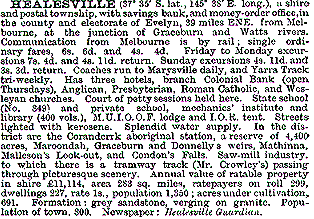
Healesville was situated on the most convenient coach route to the goldfieldsin the Woods Point area, and it was the place where fresh horses were takenfor the ascent to Fernshaw and Blacks Spur. In 1881 The Australian Handbookdescribed Healesville as –

healesville1.gif

As the Gippsland goldfields declined some miners took up farm occupations in Healesville. Timber cutters found employment, and hop gardens were established.In 1881 the railway had been opened between Hawthorn and Lilydale, 12 km.south-west of Healesville. Expectation of the railway’s extension to Healesville stimulated business and population growth. In 1889 the railway link was opened, two years after the Healesville shire had been created on 30 September,1887. The scenery of Fernshaw was more readily reached from the Healesville train terminus and tourism entered Healesville’s local economy. Gracedale House of 60 rooms was built in 1889.

sset1.gif

Farming developed in the newly cleared Don and New Chum Creek Valleys.Upstream on the Watts River the Maroondah Weir was built in 1891, the watershed requiring the removal of the Fernshaw township and curtailment of timber cutting. In 1893 the library and Mechanics’ Institute was opened. Despitethe limit put on timber cutting, Healesville’s economy grew – day outingsand travel to cool mountain retreats brought hundreds of people. The Australian Handbook’s description of Healesville in 1904 was –

healesville2.gif

Orchards and vegetable growing increased their acreages, along with a successful increased tobacco plantation. Elaborate country-retreat residences were built alongside hotels and guest houses, and a Tourist and Progress Association was created before 1914. In the 1920s the Association published “Healesville, The World-famed Tourist Resort”, listing over 40 beauty spots and 20 hotels and guest houses. The construction of the Maroondah Dam in 1927, replacing the weir, brought several hundred workmen to Healesville.Their departure, and the onset of the 1930s depression exposed Healesville’s restricted range of industries. Timber and tourism were not stable enough for sustained growth. Notwithstanding the depression, the 1930s saw increased motor tourism, partly bypassing Healesville, and decreased railway patronage.Only 10% came by rail in Easter, 1934. Tourism was still active but a local newspaper commented that Healesville would be “heaps better off callingitself the good-time town instead of the world-famed-tourist-resort – that’sgot whiskers on it.”

In 1934 the Sir Colin Mackenzie Sanctuary for Australian Fauna and Flora was opened on land that was formerly part of the Coranderrk reserve. The Healesville Sanctuary became one of Victoria’s premier tourist attractions.

The outbreak of the second world war stimulated timber cutting, which initially concentrated on harvesting trees damaged in the extensive Black Friday bushfire of January, 1939. The early postwar years saw a resumption of traditional Healesville tourism, while petrol shortages lasted, but motortravel gradually made Healesville a wayside stop for many travelers. The Australian Blue Book described Healesville shire in 1949 as –

healesville3.gif

Forestry operations in he 1940s had increased Healesville’s population,and continued activity was required to sustain them. During the 1950s theshire unsuccessfully contested the Melbourne and Metropolitan Board of Worksview that the watersheds should be kept unlogged. Small industries makingfoundation garments, knitwear, electrical appliances and soft drinks contributedto a much needed diversification of employment activities. The Golf Houseguest house was taken over the for RACV Country Club in 1951. In January,1957, a new hospital was opened and in 1961 the central school (1952) wasreplaced by a high school. A new swimming pool was opened in 1964.

Healesville shire until the 1950s had undergone only minor boundary adjustments. However, the relatively close Yarra Glen had more in common with Healesville than with Eltham shire, and the Yarra Glen district wasadded to Healesville shire on 18 June, 1958. Northwards, Buxton went toAlexandra shire on 1 October, 1963. Healesville remained the larger commercialcentre in its shire, having 64 commercial establishment compared with 35in Yarra Glen in 1988.

The township has a comprehensive range of facilities. In addition tothe shopping centre there is a district hospital, Queens Park with a swimmingpool and sports facilities, a showgrounds and sporting complex, five churches,halls, Catholic school and State primary and high schools.

Healesville shire ceased on 15 December, 1994 when part was united withparts of Whittlesea city and Diamond Valley shire and most of Eltham shire to form Nillumbik shire. The other part was united with Alexandra and Yea shires and parts of Whittlesea city and Broadford, Euroa and Eltham shires to form Murrindindi shire on 18 November, 1994. At that time Healesville shire contained the localities of Badger Creek, Christmas Hills, Toolangiand Yarra Glen.

Healesville’s census populations have been 207 (1881),907 (1901), 2,035 (1933), 3,566 (1954) and 6,264 (1991).

Healesville shire’s census populations, after most of the significant boundary changes, were 5,941 (1961), 9,670 (1981) and 11,755 (1991). The urbanisation of Healesville shire was reflected in the median house price rising from 70% to 80% of the metropolitan average between 1981 and 1986.

Further Reading:

  • Symonds, Sally, “Healesville, History in the Hills”, PioneerDesign Studio, 1982.

Violet Town

Violet Town is on the route between Melbourne and Albury and is 150 km., north-north-east of Melbourne. It is between Euroa and Benalla and is bypassed by the Hume Freeway (and former Hume Highway) which are to the south.

Major Thomas Mitchell, Surveyor-General of New South Wales, passed through the Violet Town area in Spring, 1836, on his Australia Felix expedition. He noted in his account of the expedition that several streams and chains of ponds were crossed and one, from which flowers were growing, was called Violet Ponds. That site was one of two (the other being Mitchell town) which were surveyed in 1838 as sites for townships. Violet Ponds was chosen as a site for policing the overland route to Melbourne, particularly after the Faithfull massacre in 1838. (The police post, though, was placed at Benalla.)

Not withstanding Violet Ponds’ official township status, pastoral entrepreneurs were soon acknowledged as being competent to choose settlement places, and Violet Town became only one among many along the Sydney road. However, the surveyed site was flood prone, and a more suitable location to the south-east was settled in 1852 for the township, by when the area was being crossed by travelers to the north-eastern gold fields. It was also known as Honeysuckle, adopting the name of Honeysuckle Creek (formerly Violet Ponds, but being noted for Banksia/honeysuckle rather than violets) and the name of the Honeysuckle pastoral run.

Violet Town was at the conjunction of the Sydney road, the overland telegraph and the tracks to Bendigo and north-eastern gold fields. By the1860s it had three hotels, a Wesleyan school, bakery, several tradesmen and numerous selectors on the former Honeysuckle run. When the railway line was opened in 1873 the commercial area moved northwards from the old High Street to a few blocks away.

By then the gold fields traffic was less, and towns such as Euroa and Benalla overtook Violet Town. Until Violet Town achieved its own local government in 1895 it was part of Benalla shire (1869) and part of Euroa shire (1879).

Violet Town’s street names maintain a floral tradition: Cowslip and Tulip Streets are the main ones, crossed by Orchid, Rose, Lily and Hyacinth Streets.

When Violet Town shire was created on 11 April, 1895, it was in the midst of moderate growth. Rainfall encouraged dairying, but too much rain caused impassable roads, which the Euroa shire was hard pressed to maintain.The Australian Handbook, 1903, described Violet Town –

violettown.gif

At the turn of the century Violet Town was probably at a population pinnacle. Wood cutting augmented dairying, but the wood was gradually cutout and rabbit infestation worsened, particularly after the years of good rainfall when rabbits were drowned in the warrens. Between 1911 and 1961the populations of the town and the shire declined, but after then the towngrew. Dwellings in the town grew from 459 (170) to 700 (1994), and the town’s population increased proportionately.

To travelers using either the Hume Highway or Hume Freeway Violet Town has been unrevealed. The town’s streets are attractively tree-lined and uncongested by through traffic: the only through vehicles are the trains. The town has generous public reserves, with a training track, golf course, bowling green tennis courts and a caravan park near Honeysuckle Creek. There are also a memorial hall, swimming pool, bush-nursing home and a library. Away to the south are the Strathbogie Ranges.

violettwnfootyth.jpg


Gynasium F.C. Violet Town Premiers Vict. Assn 1908
(Image courtesy of Tony Davies, London. U.K.)

The Violet Town shire had 155,000 head of sheep and lambs and 12,000head of cattle in 1994.

On 18 November, 1994, most of Violet Town shire was united with most of Euroa and Goulburn shires and parts of McIvor shire and Seymour rural city to form Strathbogie shire. The balance of Violet Town shire was incorporatedin Delatite shire. Violet Town shire was six months short of its century.

Violet Town’s census populations have been204 (1861), 643 (1901), 444 (1966) and 598 (1991). The shire’s census populations were 2,447 (1911), 1,186 (1971) and 1,443 (1991).

Further Reading:

George Town

George Town is on the eastern side of the mouth of the Tamar River, about 45 km. north of Launceston. It is the administrative centre of the George Town municipality of 650 sq. km., which has Bass Strait as its northern boundary.

George Town was fleetingly settled by a party under Lieut. Colonel William Paterson in 1804. The settlement was soon moved down the Tamar to Launceston. In 1812 Governor Lachlan Macquarie proposed that the site of George Town (named after King George III), would be better than Launceston and in 1816 the town was laid out. The first occupants were a military station, a female factory and a few settlers. The Bigge report of 1825 reversed Macquarie’s decision to make George Town the administrative centre instead of Launceston. In the 1830s George Town was an embarkation point for settlers moving to the Port Phillip district (e.g. Dutton, Henty and Batman).

George Town remained a place of small settlement until the 1870s, when gold was discovered at a number of nearby places. The population rose from150 (1869) to 260 (1880), but access remained confined to the river. It did not become a municipality until 1907. The description in the 1904 edition of The Australian Handbook was –

… a watering-place at the mouth of the River Tamar, on the east bank,in the county of Dorset, electorate and police district of Georgetown, about160 miles NW. of Hobart, 37 NW. of Launceston, and 10 miles from Beaconsfield. Steamers ply daily to and from Launceston; fare, 4s. Hotel: Planks; principal boarding-houses: Harris’, Richards’, Hopkins’. It is a post town, and has parcel post, money-order office, savings bank and telegraph station, Itis the cable station for the Australian service. There is a public library,containing 1,200 volumes, two places of worship (Episcopal), St. Mary’s and Primitive Methodist, one State school, and a private school. Road Trust,Main Road Board, Improvement Association, Court of Requests and generalsessions. Gold, iron and coal has been found in the district. Chiefly apastoral district. Good shooting, bathing, boating and fishing and salubriousclimate. Nearest towns are Exeter, 20 miles, Ilfracombe, 3 miles, Sidmouth,13 miles, York Town, 6 miles, Leonardsburg, 6 miles, and Lefroy, 10 miles.At Low Head, 8 miles distant, there is a splendid ocean beach and good boarding accommodation, also at Kelso Bay, favourite marine resort. Ratable valueof property, ‚£17,250. Capital value of district, ‚£158,257. Road Trust valuation, ‚£5,500. Agricultural returns to March 1st, 1901,were 94,175 acres worked: wheat, 138 acres; peas, 141 acres; oats, 350 acres;potatoes, 112 acres; gardens and orchards, 124 acres. Produce: wheat, 2,484bushels; peas 1,833 bushels; oats, 10,724 bushels; potatoes, 355 tons; apples,1,293 bushels; pears, 325 bushels. Stock: horses, 575; cattle, 2,239; sheep,26,490; pigs, 1,041. Population of electoral district, 3,667; town (1901census), 274.

From 1907 to 1936 the administrative centre of the municipality was at the more populous Lefroy. In 1936 the running of the Council was taken overby a commission because of the impoverishment of the municipality. The commission remained in office until 1954. Mining and fruit growing were the district’smain industries.

In 1948 constriction began on the aluminium refineries and smelter at Bell Bay, 6 km. south of George Town. Production began in 1955 under the management of the Australian Aluminium Production Commission (joint Commonwealth and Tasmanian Government’s operation). In 1961 it was sold to Comalco, which increased production capacity. The construction of the plant brought in workers, resulting in a construction-camp population and a brisk hotel trade. Comalco’s expansion led to George Town’s expansion, and other developments were attracted. These included oil terminals, a roll-on roll-off shipping terminal (1958), the Temco high carbon terro manganese plant and two wood chip companies. Bell Bay became Launceston’s container port, connected by railway,and the site of Launceston’s thermal power station (1971).

About 25% of George Town’s residential stock is public housing. In 1996a higher-than-average proportion of George Town’s residents were on unemployment or parenting allowances, and there was a high proportion of children under15.

Whilst tourism is active around George Town, the town centre does not feature as an attraction. The retail centre, however, is comprehensive,Education from kindergarten to year 10 is available.

In 1991 the Bass Strait ferry service from George Town ended and a catamaran service failed in 1996. An oil carrier, Iron Baron, ran aground near George Town in 1996. About 9 km. north of George Town is Low Head, a promontory on the east side of the mouth of the Tamar. Several of its lighthouse (1833)facilities and housing are on the Register of the National Estate.

George Town’s census populations have been 278 (1911),1,868 (1954), 4,838 (1971) and 5,026 (1991). The municipality’s census populationshave been 1,040 (1911), 578 (1933) and 6,929 (1991).

george1.gif


Promotional literature, Municipality of George Town, 1996.

Further Reading:

  • Branagan, J.C., “George Town: History of the Town and District”,Regal Publications, 1994.
  • Carroll, Brian, “Potlines and People: A History of the Bell BayAluminium Smelter”, Comalco Ltd., 1980.

Glenorchy

Glenorchy is on the west side of the Derwent River immediately north of Hobart. It is part of metropolitan Hobart andi s a separate municipality of 120 sq. km., comprising the original Glenorchy township and several suburbs.

Land grants in the Glenorchy area began in 1804. By the 1820s it was occupied by farms and was a place of rural retreat from Hobart. In 1833 a Congregational Church and a private school were opened there. The town’s name is thought to have been given by Governor Lachlan Macquarie in 1811 after his wife’s family home in Scotland.

By 1864, when Glenorchy was proclaimed a municipality, it had four churches,a school, four hotels and a tannery. There were also the Rosetta Seminaryand the Rosetta jam factory, which have bestowed their name on the suburb of Rosetta. A coach road ran to Hobart and a ferry across the Derwent Riverwent to Risdon.

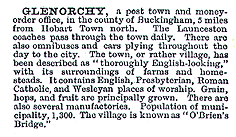
Orcharding became a significant industry, with the first cool store being built in the 1880s. Glenorchy’s hills and streams became an attraction fortourists, their coolness bringing relief from heavy clothes in summer heat.German farming immigrants settled about 10 km. west of Glenorchy at Bismark and Glenlusk. The village-like township was described in The Australian Handbook, 1875, as –

glenorchy1.gif

The railway had been connected to Glenorchy in the 1870s, and the connection by tram to Hobart came in 1893. Settlement and farming continued, and a branch railway line was built to what became Glenorchy’s main recreation venue, the racecourse at Elwick (now Goodwood). The Australian Handbook’s description in 1904 was –

glenorchy2.gif

After the first world war the Glenorchy district attracted two large industrial plants – the Electrolytic Zinc Company at Lutana, opposite Risdon,and the Cadbury chocolate factory at Claremont at the northern end of the Glenorchy municipality. Industrial development became more important inthe 1920s as apple prices slumped, and orchards at Moonah were subdivided for housing. Glenorchy began to merge with metropolitan Hobart.

In 1936 the Auditor-General reported on the municipality’s finances,resulting in the Government appointing a three-man commission to run the Council for six years. Their time coincided with business expansion in Moonah, which overtook Glenorchy township. During the postwar years the Glenorchy municipality underwent more industrial expansion than had occurred after the first world war. Cadbury’s employed over 1,000 people, Austral Bronze 350 people, and the Zinc Company 1,600 people. Alcorso Silk and Textiles had 1,000 employees at its peak. In 1949 the Daffodil table margarine factory was opened at Derwent Park, followed by a potato crisps plant in 1951. The Australian Blue Book’s description of the Glenorchy municipality in 1949 was-

glenorchy3.gif

In 1952 the Brooker Highway from Hobart to Berriedale was begun, facilitating motor-car access to Glenorchy. It put pressure on congested shopping areasin Moonah and Glenorchy, and the Council undertook street-widening and off-street-parking works. By 1964, when Glenorchy was proclaimed a City, over 150 industrial establishments employed more than 50,000 people. The last orchards were subdivided in 1972.

Glenorchy municipality’s census populations have been 3,393 (1911), 14,493 (1947), 35,682 (1961) and 42,172 (1991).

Further Reading:

  • Alexander, Alison, “Glenorchy 1804-1964”, Glenorchy City Council,1986.

Bell Park

Bell Park is a residential suburb between Geelong North and Bell Post Hill. It was named after the Bell Park homestead, built by an early settler, John Bell. Part of the homestead is preserved in the buildings at the Grace McKellar Centre for Rehabilitation and Extended Care.

The residential settlement of Bell Park beganin the 1950s, and many of the new settlers were postwar European migrants. Two of the larger groups were Croatians and Italians. Many built make-do bungalows until they earned enough to build better finished dwellings. BellPark was made a separate Catholic Parish, and the Holy Family school and church are about central to Bell Park. Nearby is a Croatian community hall in a shopping area, along with the high school (1959) and the technicalschool (1968). They are now secondary colleges. There are also Greek Orthodox,Ukrainian (two), Russian Orthodox, Serbian Orthodox and Macedonian Orthodox churches.

There are two reserves with soccer fields adjoining the schools. A linearreserve runs along Bell Park’s northern boundary, Cowies Creek. At the southernend of Bell Park there are the Geelong Golf Club’s links and the Grace MaKellarCentre.

In 1987 and 1996 the median house prices in Bell Park were $53,000 and $84,000 respectively.

Further Reading:

Gibson, Norm, (ed.), “A Fresh Start in a New Land”, (oral history),Shire of Corio, 1988.

Wynd, Ian, “So Fine A County: A History of the Shire of Corio”,Shire of Corio, 1981.